V0Under review
Airframe and manual control
Helium lift, four-corner propulsion, tethered motion, and stop on link loss
- Prototype development
- Validation test
Physical AI Companion
When microrobots can sense and make decisions, even cramped, complex, hard-to-reach spaces become places we can explore.
Concept and design / Oscar Yeh · Oscar Digital Technology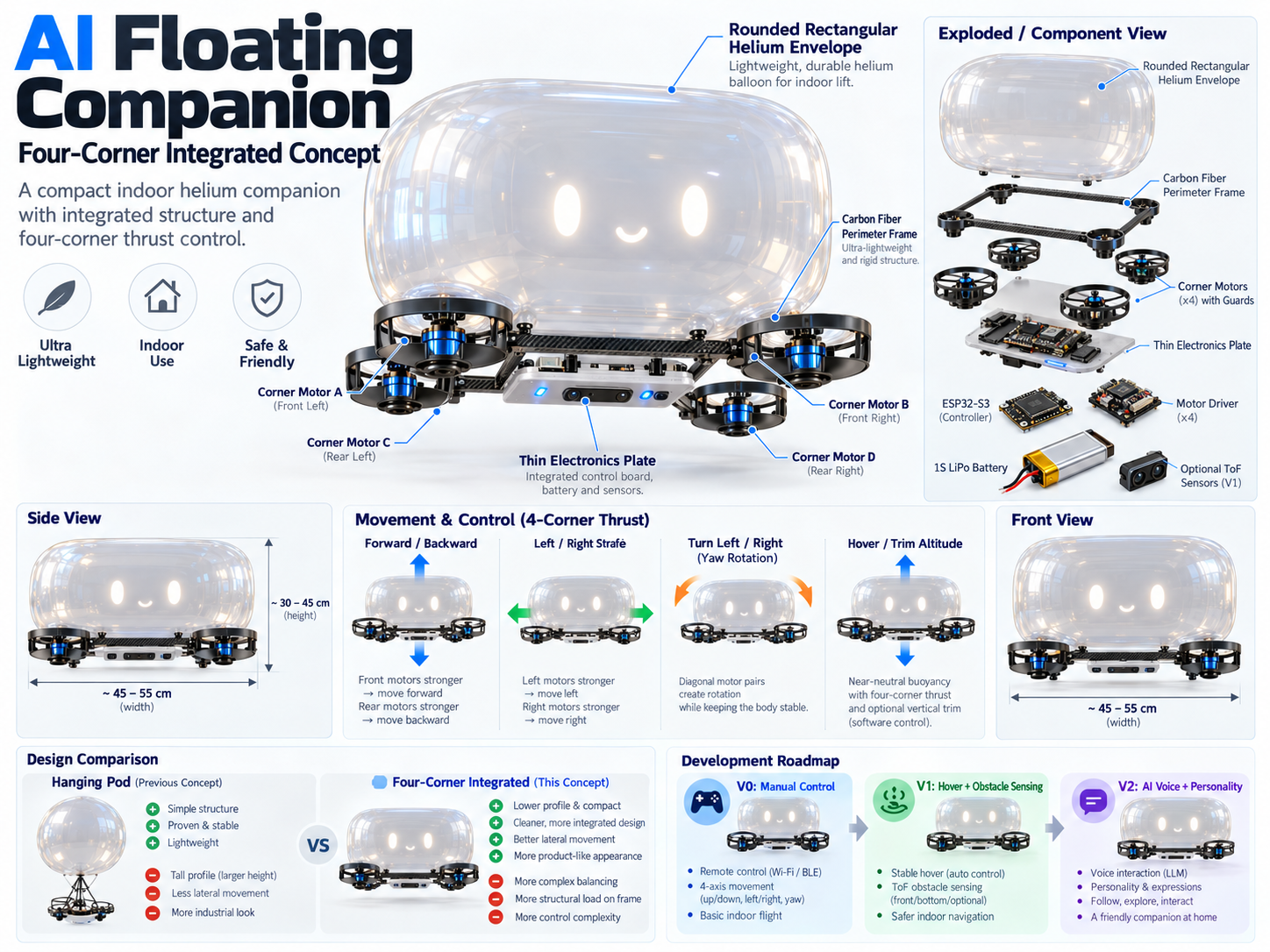
The project direction and development plan are being reviewed. The roadmap below is retained as a reference and will be updated as the plan evolves.
Helium lift, four-corner propulsion, tethered motion, and stop on link loss
ToF / IMU altitude hold, collision avoidance, and manual takeover
Person detection, follow distance, and latency
Onboard and Bluetooth headset audio, latency, and echo
Summary storage, preference retrieval, and response context
AprilTag localization, route planning, and safe movement
Low-battery return, alignment, and charging safeguards
Voice, vision, memory, navigation, and sustained safe interaction
TORY explores the intersection of AI microrobots and intelligent control. Sensors gather environmental data, a control system selects actions, and actuators move and perform tasks. Actual capabilities depend on size, materials, power, and surroundings.
Detect position, obstacles, or target signals to build useful environmental context.
Adjust routes, speed, or behavior based on goals and live feedback.
Use scale-appropriate actuation to move, collaborate, or send data.
Different scales call for different engineering solutions. These are areas to explore, not finished product features.
Explore pipes and equipment gaps that are hard for people to reach, gathering condition data.
Measure changing conditions across a controlled setting for more detailed observations.
Study how multiple units divide work, avoid obstacles, and share limited information.
Define the setting first, then choose size and actuation; validate control through small experiments.
Specify the movement area, measurements, and success criteria.
First verify movement, sensing, control, and data transfer.
Apply suitable models to localization, path planning, or anomaly detection.
Compare task success and failure modes in repeatable test settings.
Built around low cost, validation, and iteration, Floating Companion uses helium for primary lift and motors for motion and attitude adjustments. The design aims to reduce power use and noise during sustained indoor flight, with protective and control measures for safer close interaction. This is currently a concept and prototype plan.
Current status: project under revision. This phase description is retained as an earlier concept, pending an updated development plan.
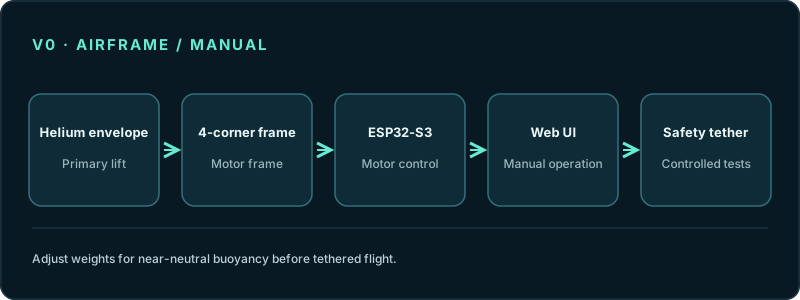
No rapid rise or descent with motors off; controlled forward/back and lateral movement and turning; fine altitude adjustments; automatic stop on Wi-Fi loss; no motor-induced controller brownout or reboot.
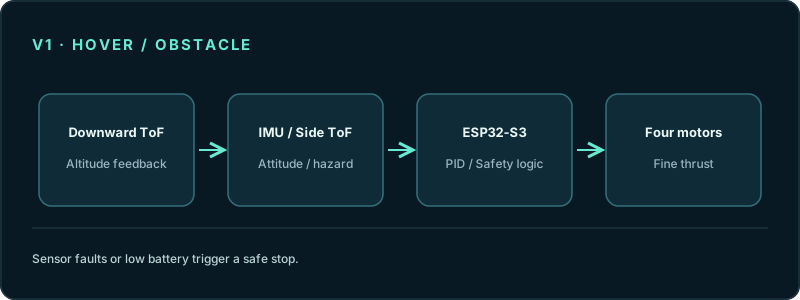
Maintain a set altitude; stop or correct near obstacles; sensor faults never drive motors to full power; users can take over at any time.
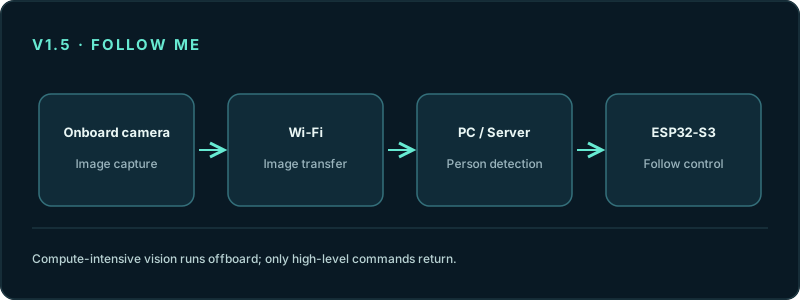
Send camera footage over Wi-Fi to an existing PC or server for person detection, then return high-level commands to ESP32. Goals: find the user, maintain distance, follow laterally, and face them.
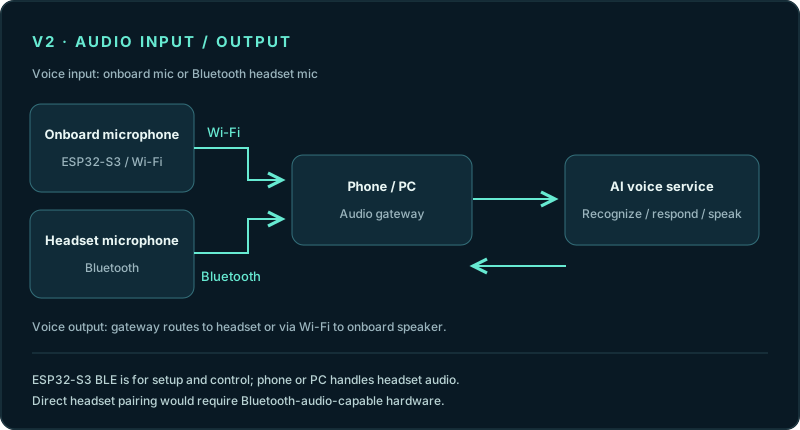
Add a microphone, speaker, and AI voice via Wi-Fi to a PC or cloud AI, gradually developing real-time speech, an original character voice, personality, and contextual responses.
ESP32-S3 Bluetooth remains for provisioning and control. It does not support Classic Bluetooth or LE Audio, so direct ESP32-S3-to-headset audio is not planned at this stage. Direct headset pairing would require different Bluetooth-audio-capable hardware.Espressif Bluetooth audio specifications ↗
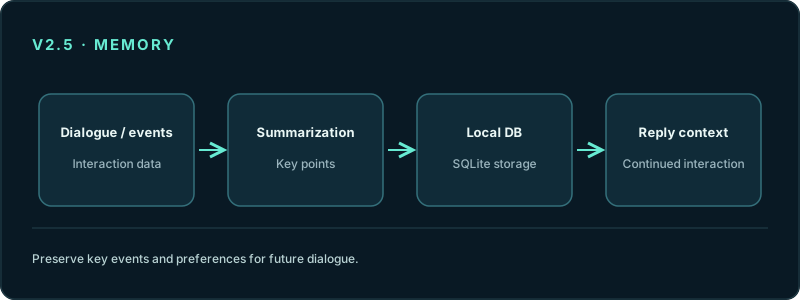
Store important events, conversation summaries, and user preferences in a local SQLite database.
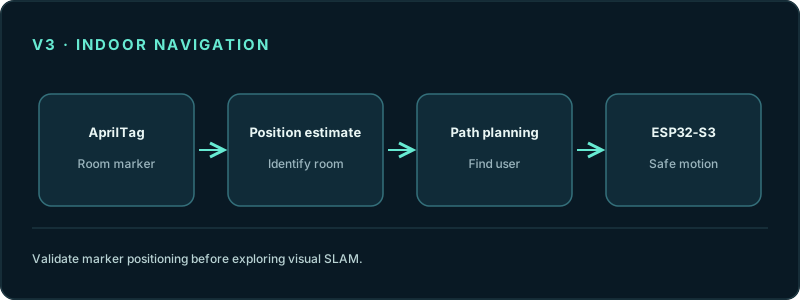
Start with low-cost AprilTag or room-marker localization; explore visual SLAM if needed. Goals include room recognition, finding the user, and simple path planning.
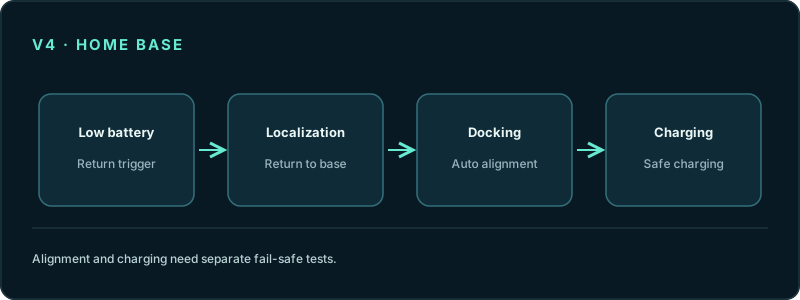
Develop docking and charging so the robot returns to its home base, aligns, and charges on low battery.
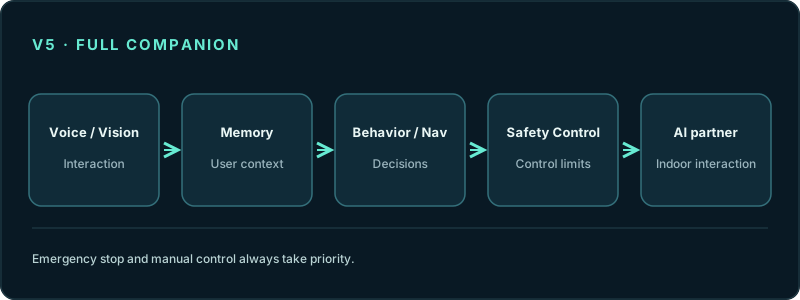
Integrate voice, vision, memory, navigation, behavior, and safety control toward an embodied AI agent that can interact indoors for extended periods.
Primary communication uses 2.4 GHz Wi-Fi. For a multiroom space of roughly 165 m², use a router, access points, or mesh for coverage; BLE supports initial setup, maintenance, and nearby fallback.
Floating Companion → Wi-Fi → Home Router / Mesh → PC / AI Server、Smartphone、Internet / Cloud AI
Share your thoughts about TORY or Floating Companion.